
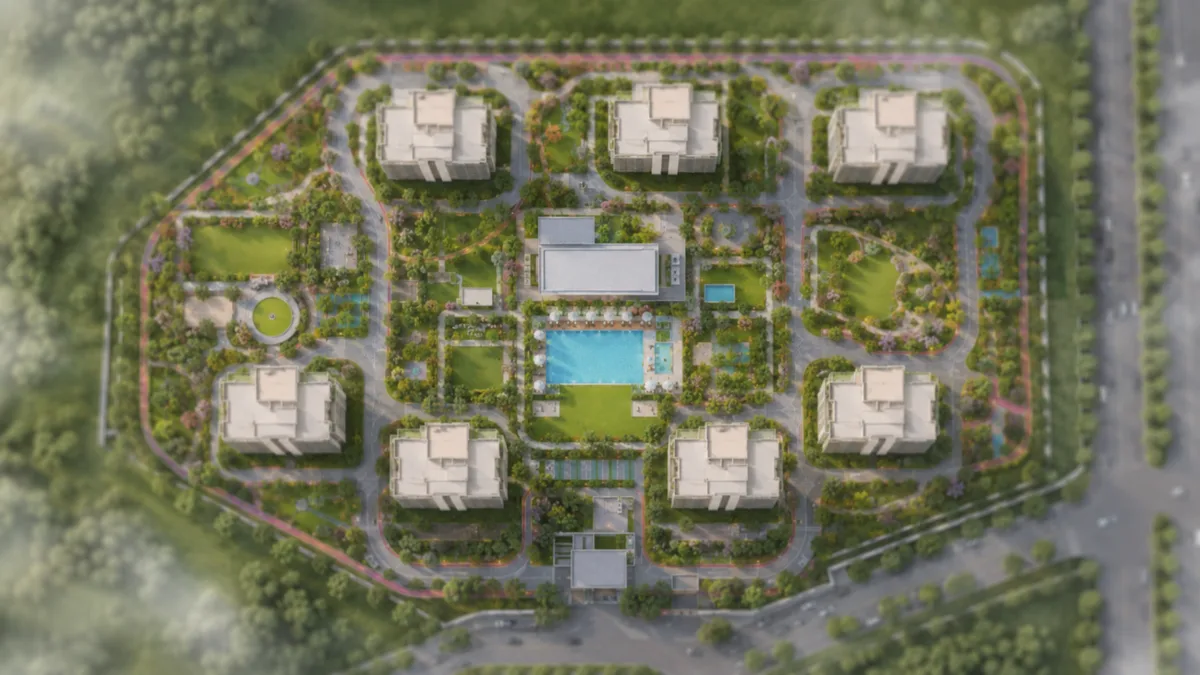
The density decision
The master plan's defining choice is density. The 7.51 acres that a high-density developer would fill with well over a thousand compact units carries 590 homes here, across five towers with six apartments on a typical floor. Every downstream feature of the plan - the tower spacing, the open-space ratio, the contention for amenities - follows from that one decision. SNN Electronic City is useful for the site-planning lens because buyers should read open space, movement, parking, and amenity placement as everyday-use details, not brochure decoration.
| Total site area | 7.51 acres (30,412 sq m) |
| Saleable area | ~1.0 million sq ft |
| Open land | About 56% (17,022 sq m) |
| Towers | 5 (A to E) |
| Floors | Ground + 20 floors of homes, 68.4 m |
| Homes per floor | 6 (5 on floors 1 and 2) |
| Total homes | 590 |
| Tower spacing | 30 – 40 ft |
| Lifts | 3 high-speed lifts per tower |
| Car parking | 991 covered, in 2 basements |
| Clubhouse | About 3,733 sq m (40,000+ sq ft) |
| Sanctioned FAR | 2.744 |
Tower layout and spacing
The five towers, A to E, each rise 20 floors of homes to 68.4 m and are set with 30 to 40 feet of spacing between them. That spacing is a quiet but important number. In a tightly-packed high-density layout, the lower floors of one tower look straight into the next, daylight struggles to reach the base of the buildings, and the gaps between towers become light wells rather than usable landscape. At Signature Regal's spacing, the lower floors keep their outlook, daylight reaches the base of each tower, and the space between towers is wide enough to function as landscaped open space.
Open space and landscape programming
About 56% of the site - 17,022 of 30,412 sq m - is left uncovered by buildings, and with every car parked below ground that open land is shared by far fewer households than a high-density project would put on it. It is programmed as layered landscape rather than a single shared deck: a zen garden, an aroma garden, and tropical greens; jogging and cycling tracks that thread through the landscape; basketball, badminton, squash, mini-soccer and mini-golf courts; a party lawn, amphitheatre seating, and picnic and barbecue areas; and kids' play and water-play zones with podium activity decks. The clubhouse anchors the central amenity precinct, and residents from any tower reach it via the landscape without crossing a road. Because the open space is distributed rather than concentrated, recreation is genuinely close to every tower, not stacked on a single deck that residents at the far end of the site rarely reach - one of the practical advantages of designing the ground plane around a low unit count.
Three high-speed lifts per tower
Vertical circulation is one of the quietest but most consequential design numbers in a high-rise community, and Signature Regal provisions three high-speed lifts per tower for a population of just six apartments per floor. The ratio matters in the most ordinary moments: the morning departure for the office, the evening return, the move-in, the grocery run. In a high-density tower where two lifts serve ten or twelve units per floor, the peak-hour wait is a daily friction; at three lifts to six units, the wait is short even at peak, and a lift out of service for maintenance leaves two still running rather than one. It is the same low-density logic as the rest of the plan, applied to the part of daily life that residents notice every single day.
A ground plane for people, not cars
No apartment sits at ground level: homes begin on the first floor, five to a floor on floors 1 and 2 and six from the third floor up. The ground level of each tower is given to the entrance lobby and landscape, and all 991 car parks are in the two basements. The result is a ground plane that belongs to residents on foot - gardens, play areas and walking routes running between the towers - with private outdoor space provided as balconies on every home.
Parking, circulation and the density math
The 991 covered car parks - about 1.7 per apartment - sit in the two basement levels, an over-provision in a market where parking shortfalls are a recurring long-term dispute in older projects. Vehicle circulation is planned for the site perimeter and the basement ramps, so the central spine and the pedestrian routes stay traffic-free. On the density math, the plan is sanctioned at a floor area ratio of 2.744 on 30,412 sq m of land, delivering close to 1.0 million sq ft of saleable apartment area at about 79 homes an acre - moderate for a high-rise community, and consistent with the low-density positioning that the rest of the plan expresses.
How the master plan reads for buyers
Each planning decision has a consequence a resident actually feels, and the table below maps the two. This is the most useful way to read a master plan: not as an abstract layout, but as a set of choices that determine daily life.
| Decision | Consequence for residents |
|---|---|
| 6 units per floor | Short lift waits, quiet corridors |
| 30 – 40 ft tower spacing | Privacy, daylight, ventilation |
| About 56% open land, parking below ground | Less-contended parks and amenities |
| Distributed amenity zones | Nearby recreation from every tower |
| 991 covered car parks | No long-term parking shortfall |
| Vehicle / pedestrian separation | Safe, walkable internal landscape |
The contention ratio the plan creates
The master plan's most consequential number is not on the plan at all - it is the contention ratio it creates. Spreading the open half of the site and the 150-plus amenities across 590 households, rather than the 1,050 to 1,240 a high-density project of similar acreage would carry, roughly halves the number of residents competing for the same pool lane, the same court slot, and the same stretch of jogging track. The same logic applies to the lifts: three high-speed lifts serving six units per floor is a generous ratio, so the morning queue is short even at peak. A buyer evaluating two projects of similar acreage and amenity count should look past the headline list to this ratio, because it is what determines whether the facilities are usable in practice or merely present on a brochure.
Construction sequence and the clubhouse handover
All five towers and all 590 homes are registered together under one Karnataka RERA registration, with construction started on 1 August 2026 and completion committed for 31 July 2031. Within that window, towers may still be finished and handed over in sequence. Buyers should ask which tower is scheduled first and when the clubhouse and pools will be handed over, since a clubhouse that completes only with the final tower changes the early-occupancy experience materially. The floor-plans page details the configurations, the amenities page covers the facility set the plan supports, and the reviews page lists the diligence steps to take before booking.
Read as a whole, the master plan is the clearest single expression of what Signature Regal is trying to be. Every number on it - five towers, six homes on a typical floor, 30-to-40-foot spacing, parking entirely below ground, three lifts per tower, 991 covered car parks - points in the same direction: trade unit count for living quality. That coherence is itself a signal of intent, because a plan that compromised the density to squeeze in more sellable units would show the compromise in the spacing, the open land, or the parking provision. The registered plan holds those numbers, and checking your own tower and unit against it is the diligence step that matters most here.
Signature Regal Master Plan FAQs
How is the 7.51-acre site laid out?
As five residential towers of 20 floors within a landscaped ground plan, with 30 to 40 feet of spacing between towers, about 56% of the land left open, a central amenity precinct with the clubhouse and pools, and vehicle movement kept to the perimeter and the two basements.
Why does the 30-40 ft tower spacing matter?
It keeps the lower floors from looking straight into a neighbouring tower, preserves daylight at the base of each building, and gives the space between towers room to function as usable landscape rather than a light well.
How much parking and how many lifts?
991 covered car parks in two basements - about 1.7 per apartment - and three high-speed lifts per tower for the small per-floor population.
What is the density math?
The plan is sanctioned at a floor area ratio of 2.744 on 7.51 acres, giving 590 homes and close to 1.0 million sq ft of saleable area - about 79 homes an acre, moderate for a high-rise community.
Is the project registered in phases?
No. All five towers and 590 homes are covered by one Karnataka RERA registration with a single completion date, 31 July 2031. Buyers should still ask which tower is scheduled first and when the central amenity precinct is handed over relative to first occupancy.